In physics, a quantity that has both magnitude and direction. It is typically represented by an arrow whose direction is the same as that of the quantity and whose length is proportional to the quantity’s magnitude. Although a vector has magnitude and direction, it does not have position. That is, as long as its length is not changed, a vector is not altered if it is displaced parallel to itself.
/www.britannica.com/
Vector quantities are often represented by scaled vector diagrams. Vector diagrams depict a vector by use of an arrow drawn to scale in a specific direction. Vector diagrams were introduced and used in earlier units to depict the forces acting upon an object. Such diagrams are commonly called as free-body diagrams. An example of a scaled vector diagram is shown in the diagram at the right. The vector diagram depicts a displacement vector. Observe that there are several characteristics of this diagram that make it an appropriately drawn vector diagram.
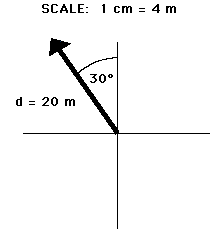
- a scale is clearly listed
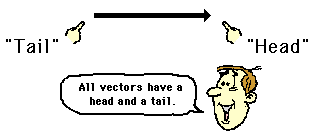
- a vector arrow (with arrowhead) is drawn in a specified direction. The vector arrow has a head and a tail.
- the magnitude and direction of the vector is clearly labeled. In this case, the diagram shows the magnitude is 20 m and the direction is (30 degrees West of North).
Conventions for Describing Directions of Vectors
Vectors can be directed due East, due West, due South, and due North. But some vectors are directed northeast (at a 45 degree angle); and some vectors are even directed northeast, yet more north than east. Thus, there is a clear need for some form of a convention for identifying the direction of a vector that is not due East, due West, due South, or due North. There are a variety of conventions for describing the direction of any vector. The two conventions that will be discussed and used in this unit are described below:
- The direction of a vector is often expressed as an angle of rotation of the vector about its "tail" from east, west, north, or south. For example, a vector can be said to have a direction of 40 degrees North of West (meaning a vector pointing West has been rotated 40 degrees towards the northerly direction) of 65 degrees East of South (meaning a vector pointing South has been rotated 65 degrees towards the easterly direction).
- The direction of a vector is often expressed as a counterclockwise angle of rotation of the vector about its "tail" from due East. Using this convention, a vector with a direction of 30 degrees is a vector that has been rotated 30 degrees in a counterclockwise direction relative to due east. A vector with a direction of 160 degrees is a vector that has been rotated 160 degrees in a counterclockwise direction relative to due east. A vector with a direction of 270 degrees is a vector that has been rotated 270 degrees in a counterclockwise direction relative to due east. This is one of the most common conventions for the direction of a vector and will be utilized throughout this unit.Two illustrations of the second convention (discussed above) for identifying the direction of a vector are shown below.
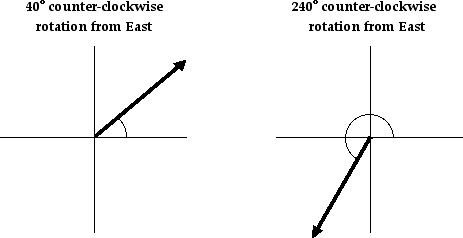
Observe in the first example that the vector is said to have a direction of 40 degrees. You can think of this direction as follows: suppose a vector pointing East had its tail pinned down and then the vector was rotated an angle of 40 degrees in the counterclockwise direction. Observe in the second example that the vector is said to have a direction of 240 degrees. This means that the tail of the vector was pinned down and the vector was rotated an angle of 240 degrees in the counterclockwise direction beginning from due east. A rotation of 240 degrees is equivalent to rotating the vector through two quadrants (180 degrees) and then an additional 60 degrees into the third quadrant.
Vector magnitude
Vectors can be graphically represented by directed line segments. The length is chosen, according to some scale, to represent the magnitude of the vector, and the direction of the directed line segment represents the direction of the vector. For example, if we let 1 cm represent 5 km/h, then a 15-km/h wind from the northwest would be represented by a directed line segment 3 cm long, as shown in the figure at left. A vector in the plane is a directed line segment. Two vectors are equivalent if they have the same magnitude anddirection.
Consider a vector drawn from point A to point B. Point A is called the initial point of the vector, and point B is called theterminal point. Symbolic notation for this vector is  (read “vector AB”). Vectors are also denoted by boldface letters such as u, v, and w. The four vectors in the figure at left have the same length and direction. Thus they represent equivalent vectors; that is,


In the context of vectors, we use = to mean equivalent.
(read “vector AB”). Vectors are also denoted by boldface letters such as u, v, and w. The four vectors in the figure at left have the same length and direction. Thus they represent equivalent vectors; that is, In the context of vectors, we use = to mean equivalent.
The length, or magnitude, of is expressed as ||. In order to determine whether vectors are equivalent, we find their magnitudes and directions.
is expressed as ||. In order to determine whether vectors are equivalent, we find their magnitudes and directions.In general, two nonzero vectors u and v can be added geometrically by placing the initial point of v at the terminal point of u and then finding the vector that has the same initial point as u and the same terminal point as v, as shown in the following figure.

The sum is the vector represented by the directed line segment from the initial point A of u to the terminal point C of v. That is, if u =
and v =  , then
u + v =
+ = 
http://www.math10.com/en/geometry/vectors-definitions/vectors.html
Vectors can be added using the parallelogram rule or the ‘nose-to-tail’ method.
Two vectors a and b represented by the line segments can be added by joining the ‘tail’ of vector b to the ‘nose’ of vector a. Alternatively, the ‘tail’ of vector a can be joined to the ‘nose’ of vector b.


This can be illustrated in the following diagram.

http://www.onlinemathlearning.com/vector-addition.html


Vector Addition
Two vectors a and b represented by the line segments can be added by joining the ‘tail’ of vector b to the ‘nose’ of vector a. Alternatively, the ‘tail’ of vector a can be joined to the ‘nose’ of vector b.
Example:
Find the sum of the two given vectors a and b.
Solution:
Draw the vector a. Draw the ‘tail’ of vector b joined to the ‘nose’ of vector a. The vector a + b is from the ‘tail’ of a to the ‘nose’ of b.
Suppose a plane is taking off at a rate of 200 mph with an angle of 35° to the ground. What is the rate at which it is receding from the ground? What is its ground
speed?
First we make a diagram. In this case, the plane’s path makes a
35° angle with the ground. We call this vector p.
The hypotenuse of the triangle is given a length of 200 mph which is the magnitude of the vector pdescribing the plane’s path. The vector representing climbing vertically away from the ground is cand the vector representing the ground speed is g. The right angle is formed between vectors cand g which are components of p.
Vector Addition is Commutative
We will find that vector addition is commutative, that is a + b = b + aThis can be illustrated in the following diagram.
http://www.onlinemathlearning.com/vector-addition.html
Example Problems
Example 1:
Suppose a plane is taking off at a rate of 200 mph with an angle of 35° to the ground. What is the rate at which it is receding from the ground? What is its ground
speed?
The hypotenuse of the triangle is given a length of 200 mph which is the magnitude of the vector pdescribing the plane’s path. The vector representing climbing vertically away from the ground is cand the vector representing the ground speed is g. The right angle is formed between vectors cand g which are components of p.
In the diagram shown below the known magnitude (||p|| = 200
mph) and angle (q = 35º)
are labeled as well as the unknown vectors corresponding to the situation: the
magnitude of the climbing speed of the plane by c, and
the magnitude of the ground speed of the plane by g.
|
|
|
